X, Reddit, YouTube, and news — all sources, in one place.

Crypto Social
Intelligence.
Ruma is the crypto social-intelligence platform for tracking sentiment, attention, and the next narratives moving crypto — in real time.
HYPE
BTC
PEPERuma by the numbers
Crypto Twitter users identified and analyzed in our database.
Top smart money accounts identified and tracked.
Tokens and projects monitored across the ecosystem.
Proprietary sentiment models trained on crypto language.
The Ruma platform
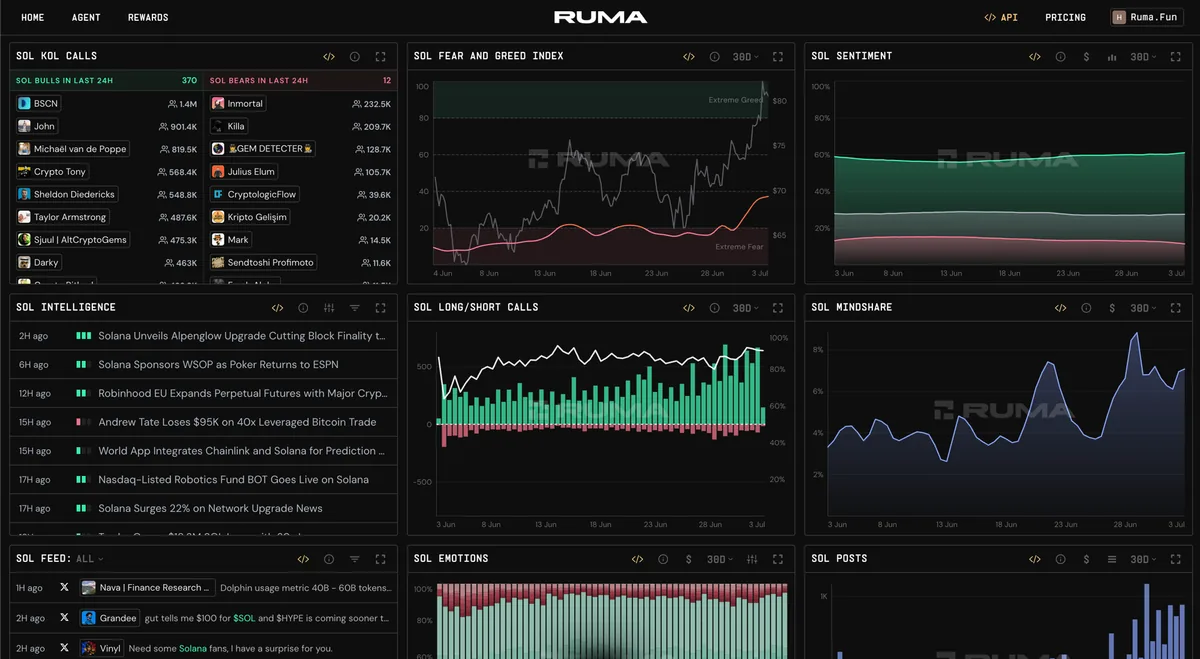
Every Social Metric
Fear & greed, sentiment, mindshare, long/short calls, emotions and more — the full social picture for any token, charted over time.
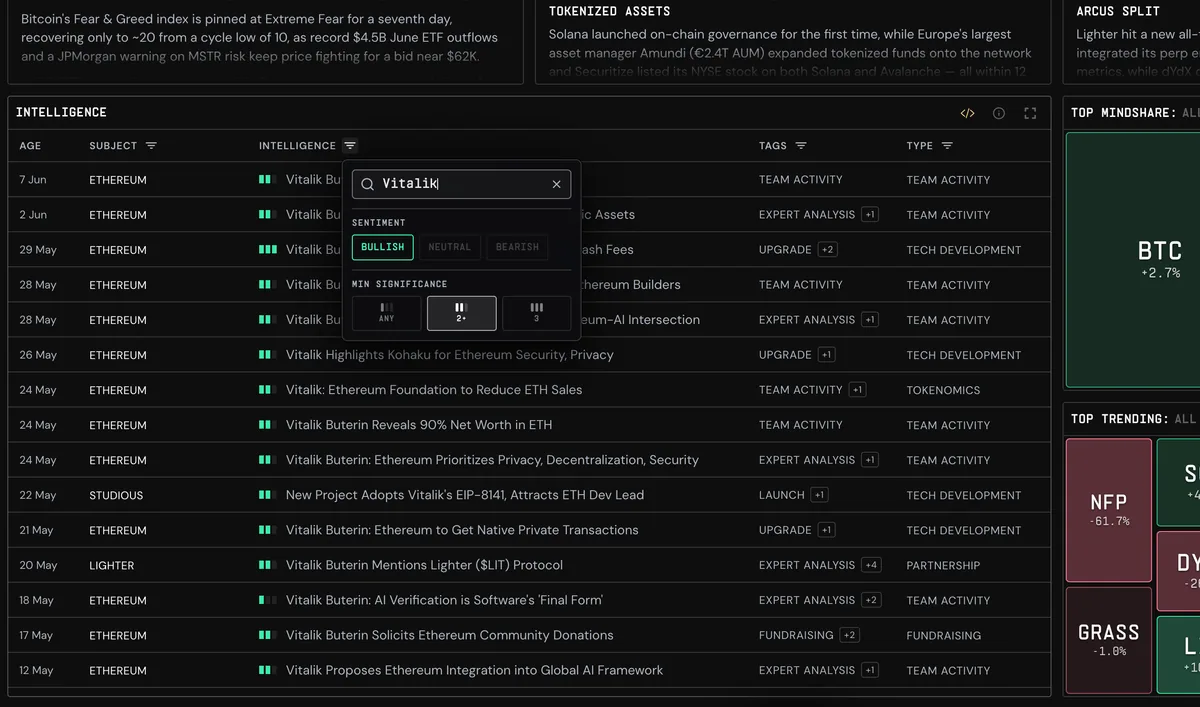
Deep Intelligence
Every meaningful event across Crypto Twitter, distilled into one filterable intelligence feed — search any subject, filter by sentiment and significance, and see what actually matters.
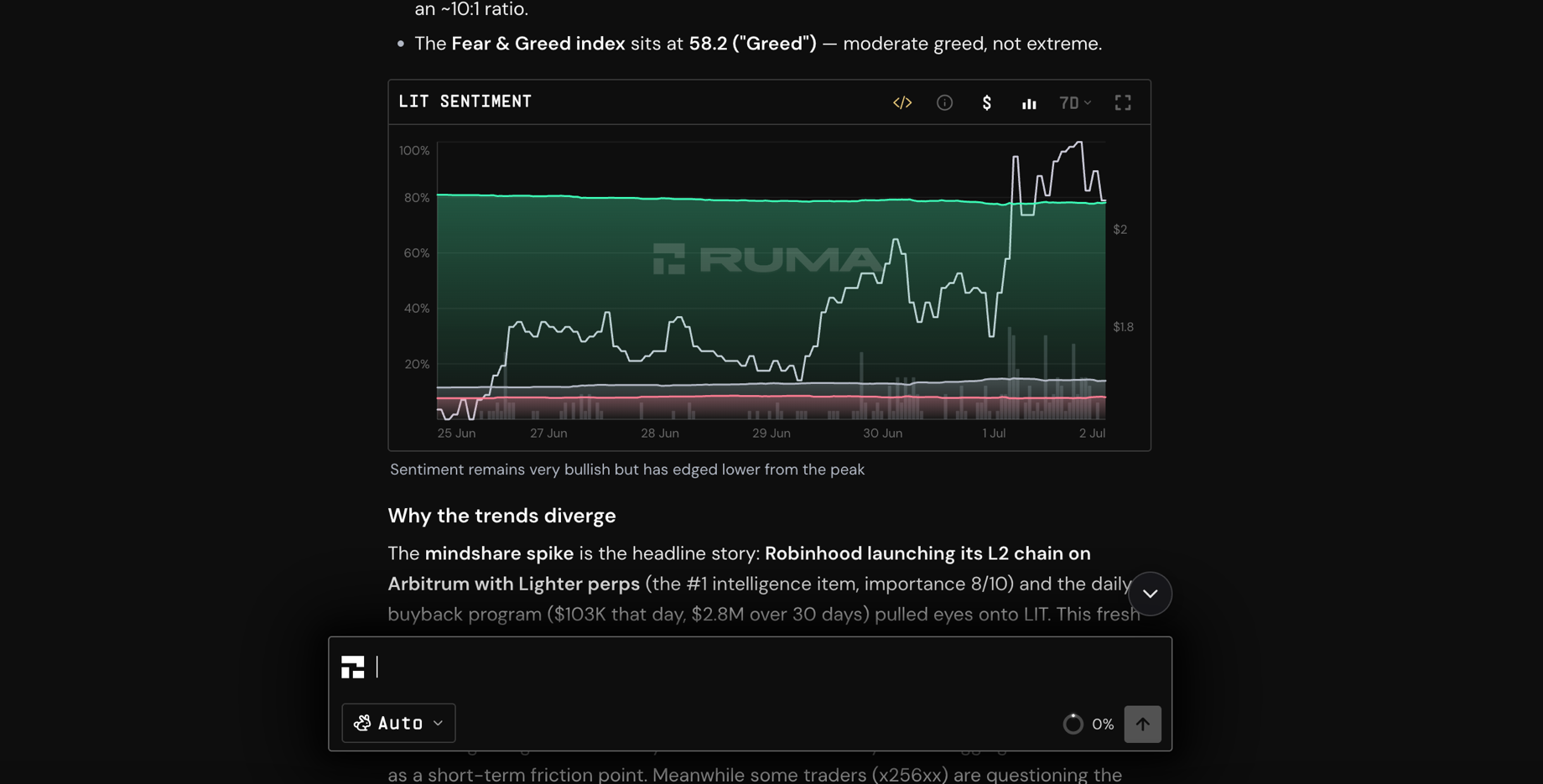
AI-Driven Research
Ask anything and let the agent pull every data point — mindshare, sentiment, KOL calls — into a structured breakdown with live charts inline.
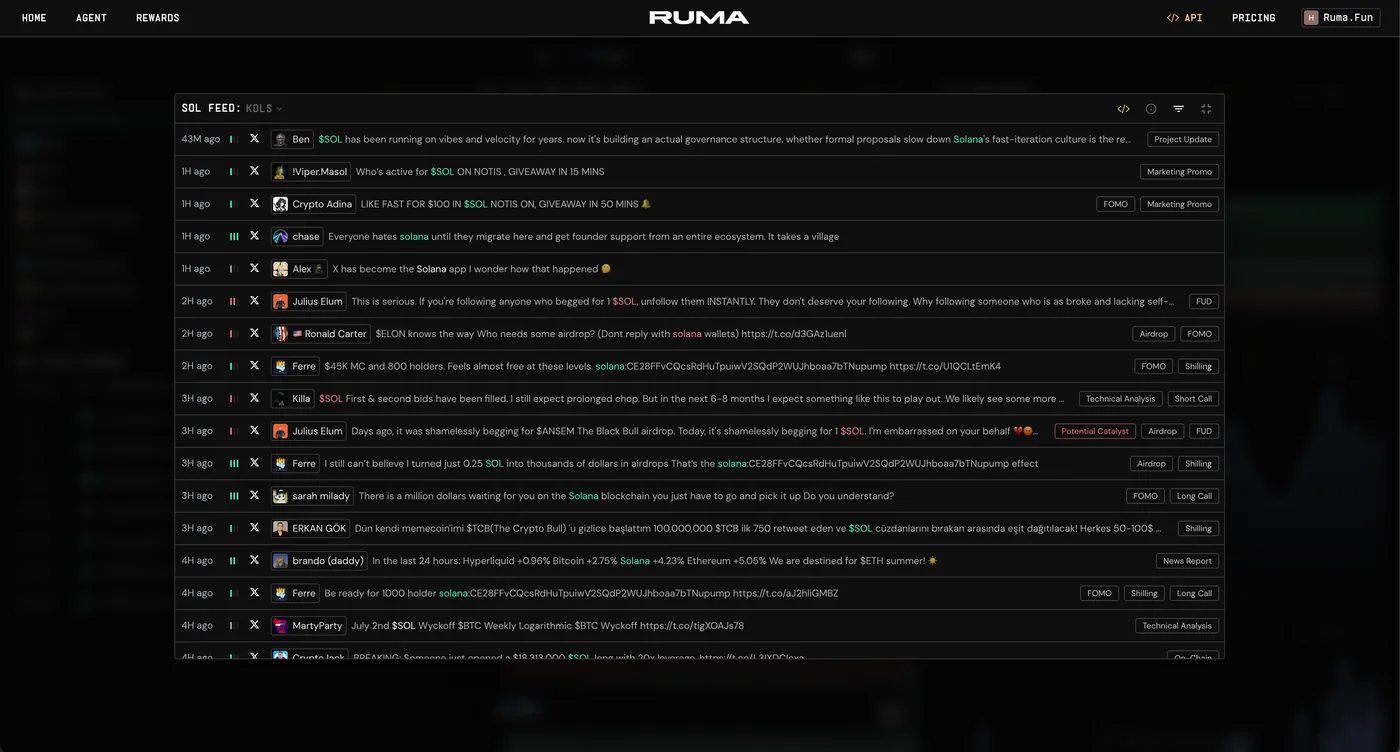
Crypto Twitter, Filtered
The entire feed, cut down to what you care about — filter to KOLs, smart money or any cohort, with every post tagged FOMO, shilling, technical analysis and more.
Built for Algorithmic & Agentic Trading
Stream real-time sentiment, mindshare and smart-money flow straight into your quant strategies and autonomous agents via API, MCP or CLI.
{
"symbol": "HYPE",
"fear_greed": 22,
"sentiment_score": -0.41,
"mindshare": { "value": 0.061, "delta_24h": 0.41 },
"cultiness_index": 84,
"smart_money": { "bullish": 0.68, "bearish": 0.12 }
}Fundamental Social Analytics
The essential social data for any token — sentiment, mindshare and follower growth — measured continuously and charted over time.
Social Sentiment
share of bullish, bearish and neutral postsMindshare
the share of all conversation a token commandsFollowers
a project's X follower count over timeRuma's Proprietary Social Signals
Anyone can count mentions. We read every post with an LLM to build indices no one else has — fear & greed, cultiness, emotional breakdown and smart-money positioning.
Fear & Greed, For Everything
Alt.me and CoinMarketCap's Fear & Greed track Bitcoin closely — we extend the same index to every asset, so you can fade the crowd on any token, not just BTC.
The Cultiness Index
How cult-like a community really is — the delusional, near-religious conviction in how people post, the belief that holds through every drawdown regardless of price.
The Full Emotional Spectrum
Beyond bullish and bearish — we surface every emotion moving a market: fear, euphoria, uncertainty, anger and more, not just a green or red score.
Smart Money Calls
See who called the top or the bottom — track the bullish and bearish calls of the accounts that actually move markets. Hover any name to dig in.
FAQ
Crypto sentiment analysis is the practice of measuring how bullish, bearish or emotionally charged the market feels toward a token by reading what people say about it. Ruma reads every relevant social post with large language models rather than counting keywords, then distils each one into structured sentiment signals — a sentiment score, a fear and greed reading, an emotional breakdown and more — for individual assets and their communities.
Ruma continuously ingests content from across X, Reddit, YouTube and crypto news, scores each item with proprietary machine-learning models, and rolls the results up into live indices per token. Because scoring happens as content arrives, the signals update in near real time, so you can see sentiment shift on a narrative, a listing or a market move as it happens rather than hours later.
A Fear and Greed Index condenses market emotion into a single number, where extreme fear can mark a bottom and extreme greed can mark a top. Most public indices, like the ones from Alternative.me and CoinMarketCap, track Bitcoin. Ruma extends the same idea to every asset it covers, giving you a per-token fear and greed reading so you can fade the crowd on any coin, not just BTC.
Yes. Ruma tracks individual accounts and key opinion leaders (KOLs) so you can follow what specific people are posting, how bullish or bearish they are, and which calls they got right. You can surface the accounts that actually move markets, see who called a top or a bottom, and read a single person’s posts and sentiment over time.
Ruma applies proprietary machine-learning and large language models to every post it ingests. Instead of simple keyword matching, the models interpret meaning, tone, sarcasm and conviction, then output structured signals such as sentiment score, emotion, and community conviction. This lets Ruma capture nuance that traditional mention-counting tools miss and turn unstructured social chatter into clean, machine-readable data.
Ruma pulls from every major place the crypto conversation happens — X, Reddit, YouTube and crypto news — bringing all of these sources together in one place. Every post, thread, video and headline is scored by Ruma’s own models and aggregated into per-token and per-community indices, so the signals reflect the full live conversation across platforms rather than a single feed.
Yes. Every post Ruma ingests is tagged by topic and event, so you can filter the feed down to exactly the conversation you care about — airdrops, exchange listings and delistings, hacks and exploits, scam warnings, fundraising rounds, ETF and IPO news, whale activity, technical analysis, rumours and breaking-news catalysts. You can combine these filters with a specific token, sentiment or time window, and every filter is exposed through the API so you can pull the same tightly-scoped feed into your own tools.
Yes. Ruma classifies the people behind each post, so you can filter by who is talking as well as what they are saying. Read only key opinion leaders (KOLs), zoom in on a single named account, or pull whole cohorts such as founders, CEOs and other executives, developers, exchanges or media. That lets you answer questions like “what are founders posting about this listing?” or “how are CEOs reacting to the hack?” — and, because the classification is available over the API, you can build the same audience filters into your own dashboards and trading systems.
Yes. Ruma exposes its sentiment signals, indices and social metrics through an API so you can pull the same data that powers the app directly into your own stack. That makes it straightforward to build sentiment-driven strategies, backtest against historical signals, and feed real-time readings into an algorithmic or quantitative trading system.
Ruma is built to be consumed by machines as well as people. Because every signal is structured and available over the API, autonomous and agentic trading systems can query live sentiment, fear and greed, and smart-money positioning as inputs to their decisions. Ruma also offers an in-app intelligence agent for exploring the data conversationally.
The Cultiness Index is a proprietary Ruma metric that measures how cult-like a token’s community really is. It reads the near-religious, high-conviction belief in the language people post — the kind of conviction that holds through every drawdown and stays decoupled from price. It is a signal you won’t find in traditional sentiment tools and can help identify communities with unusually resilient holders.
Ruma surfaces smart-money calls by tracking the bullish and bearish positioning of the accounts that historically move markets. You can see who called the top or the bottom on a given asset and drill into any name to understand the conviction behind their calls, giving you a read on where informed participants are leaning.
Ruma goes beyond a simple green-or-red score to surface the full spectrum of emotions moving a market. It tracks fifteen distinct emotions, organised as opposite pairs: joy versus sadness, optimism versus pessimism, trust versus distrust, confidence versus fear, anticipation versus boredom, love versus disgust, and greed versus anger — plus surprise. This emotional breakdown helps you distinguish, for example, between a rally driven by genuine conviction and confidence and one driven by short-lived greed or euphoria.
Most sentiment tools count mentions or apply basic positive-versus-negative tagging. Ruma reads every post with large language models and produces proprietary indices you won’t find elsewhere: a fear and greed reading for any token, a cultiness score for its community, a full emotional breakdown, and smart-money positioning. The result is deeper, more actionable signal rather than raw volume.
Ruma provides its metrics across all assets, with over 100,000 projects already indexed in our database and new projects becoming supported automatically. Signals like fear and greed and the Cultiness Index extend across every one of them rather than just the majors. Coverage is driven by where the conversation is happening — if there is chatter about a token, Ruma will have it — so emerging narratives and communities are captured alongside established assets.
Mindshare is the share of the overall crypto conversation that a single token commands at any given moment. Ruma measures it by tracking how much of the social discussion is dedicated to each asset relative to the rest of the market, so you can watch attention rotate between narratives and spot a token gaining or losing relevance before it shows up in price.
Social volume measures how much people are talking about a token, while sentiment measures how they feel about it. Ruma tracks post volume over time alongside sentiment, so you can tell the difference between quiet conviction and a loud, crowded trade — a spike in volume with softening sentiment often signals froth, while rising sentiment on steady volume can mark genuine accumulation.
Ruma retains historical sentiment, fear and greed, mindshare and other signals so you can chart how a token’s social picture has evolved rather than seeing only a live snapshot. That history lets you compare current readings against past regimes and backtest sentiment-driven strategies against how the signals actually moved.
Extreme readings are often the most useful. Historically, extreme greed and euphoric social sentiment can coincide with local tops, while extreme fear and capitulation can mark bottoms. Ruma’s fear and greed and emotion signals are built to make these extremes visible per token, so you can fade an overheated crowd or look for exhaustion instead of reacting to price alone.
Yes. Ruma tracks the follower count of a project’s accounts over time, so you can see whether a token’s audience is genuinely expanding or stagnating. Follower growth sits alongside sentiment and mindshare as part of the full social picture, helping you separate durable community building from short-lived hype.
Yes. The per-token fear and greed reading, like Ruma’s other signals, is available through the API, so you can display a live fear and greed gauge in your own dashboard, bot or app for any covered asset rather than being limited to a single Bitcoin-only index.
You can explore Ruma’s live intelligence in the app or pull the same data into your own stack through the API. Full endpoint reference and integration details are available in the Ruma API documentation, so developers and quantitative teams can wire sentiment signals directly into dashboards, models and trading systems.